
Counting the Cost of Extinction
An Open Letter to NOAA on North Atlantic Right Whale Protection
We submitted the following letter to NOAA in response to the Advance Notice of Proposed Rulemaking to Amend the North Atlantic Right Whale Vessel Strike Reduction Rule, Docket No. NOAA-NMFS-2026-0022. Plus Nature would like to recognize the pioneering work of Ralph Chami and Blue Green Future in helping articulate the relationship between living systems and economic value.
Dear NOAA Fisheries,
On behalf of +Nature, we appreciate the opportunity to provide comments regarding NOAA's Advance Notice of Proposed Rulemaking (ANPRM) concerning amendments to the North Atlantic Right Whale Vessel Strike Reduction Rule.
+Nature is dedicated to advancing science-based approaches that recognize ecological systems as foundational infrastructure supporting climate resilience, economic stability, biodiversity, public health, and long-term human well-being. Our work focuses on helping make nature visible, valuable, and regenerative through ecological valuation, natural capital frameworks, and practical solutions that align conservation outcomes with long-term societal prosperity.
We support innovation, technological advancement, and collaborative approaches that improve conservation outcomes while strengthening the relationship between human activity and the natural systems upon which communities and economies ultimately depend.
At the outset, we wish to emphasize a central principle that should guide any revision of the North Atlantic Right Whale Vessel Strike Reduction Rule: Modernize Protection, But Do Not Normalize Extinction Risk
We support efforts to integrate real-time acoustic detection, AIS-based alerts, dynamic risk mapping, vessel-routing tools, predictive analytics, and other emerging technologies into whale protection strategies. However, these tools should function as enforceable complements to proven vessel speed protections, not as substitutes unless NOAA can demonstrate equivalent or superior measurable conservation outcomes.
Only approximately 380 North Atlantic right whales remain, making the species one of the most endangered large whale populations in the world. Every preventable mortality has population-level consequences because each individual represents a significant portion of the species' remaining reproductive capacity and future recovery potential.
Any regulatory revision or deregulation that reduces protection without demonstrably reducing risk would effectively transfer extinction risk from vessel operators and maritime commerce onto an already critically endangered species.
More broadly, this rulemaking presents an opportunity for NOAA to demonstrate a different path than an increasingly common policy tendency in which ecological benefits, public trust resources, biodiversity, and long-term resilience values are treated as uncertain, qualitative, or difficult to monetize, while compliance costs and short-term economic impacts are treated as readily quantifiable and therefore receive disproportionate weight in decision-making.
The challenge before NOAA is not whether to modernize whale protection. The challenge is ensuring that modernization strengthens conservation outcomes rather than weakening them through an analytical framework that counts the costs of protection while undervaluing the benefits of avoiding extinction, preserving ecosystem function, and protecting living ocean infrastructure.
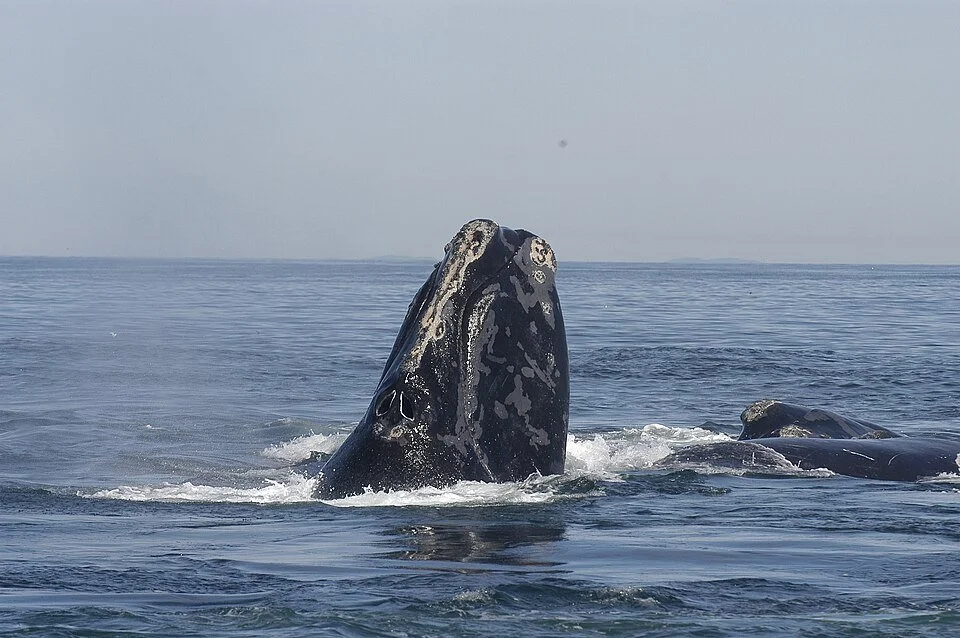
Northern Right Whales. Moira Brown and New England Aquarium, Wikimedia Commons
Existing Speed Protections Have Demonstrated Value
One of the most important considerations in this rulemaking is that vessel speed restrictions are not theoretical protections. They are among the few conservation measures that have demonstrated effectiveness in reducing vessel-strike mortality and serious injury.
NOAA's own assessments and decades of scientific research have shown that vessel speed is directly correlated with strike lethality and that mandatory speed restrictions substantially reduce the probability that a strike will result in serious injury or death. Existing speed restrictions therefore represent one of the few proven safeguards currently available to protect North Atlantic right whales.
Any proposal to weaken, replace, or reduce these protections should first demonstrate equivalent or superior biological outcomes through measurable and independently validated performance standards.
The burden of proof should rest on demonstrating reduced risk, not merely projecting future technological capability.
North Atlantic Right Whales as Living Ocean Infrastructure
The North Atlantic right whale is often viewed solely through the lens of endangered species conservation. While protection under the Endangered Species Act and Marine Mammal Protection Act remains paramount, emerging science increasingly demonstrates that large whales are also critical components of ocean ecosystem function.
Right whales are part of what may be understood as living ocean infrastructure.
Just as built infrastructure provides services that support society and economic activity, living systems generate ecological services that underpin ocean productivity, biodiversity, climate regulation, fisheries productivity, and long-term resilience.
Large whales contribute to nutrient cycling, biological productivity, food-web dynamics, and carbon sequestration processes that support healthy marine ecosystems. Scientific research increasingly demonstrates that whale populations play important roles in nutrient redistribution and ecological functioning that extend far beyond individual species conservation.
The loss of a right whale is therefore not merely the loss of an individual animal. It represents:
Loss of reproductive capacity
Loss of future ecosystem service generation
Loss of biodiversity
Loss of ecological resilience
Loss of natural capital
Increased extinction risk
From this perspective, vessel strikes represent more than a wildlife management challenge. They constitute degradation of living ecological infrastructure and erosion of natural capital assets that generate public benefits through ecosystem services, biodiversity support, climate regulation, cultural value, and long-term ocean health.
North Atlantic right whales are also part of our shared natural heritage and public trust resources held in stewardship for future generations.
Detection Is Not Mitigation
A critical distinction must be maintained between whale detection and vessel strike mitigation. Detection technologies provide information regarding whale presence. They do not, by themselves, reduce vessel-strike risk.
Risk reduction occurs only when detection triggers effective and enforceable responses such as:
Speed reductions
Routing changes
Area avoidance
Vessel operational adjustments
Other risk-reduction actions
Accordingly, NOAA should evaluate any technology-based alternative not only on its ability to detect whales, but on its demonstrated ability to produce measurable reductions in mortality and serious injury.
Detection without effective mitigation cannot be considered an equivalent replacement for proven conservation measures. This distinction is especially important as NOAA considers the future role of acoustic monitoring, artificial intelligence, vessel-based detection systems, dynamic management approaches, and AIS-based alerting tools.
Technology should be judged not only by detection performance, but by demonstrated conservation outcomes.
Technology Should Strengthen Protection, Not Replace It
+Nature supports NOAA's exploration of advanced technologies to reduce vessel strike risk. Emerging tools offer significant promise, including:
Passive acoustic monitoring networks
AI-enabled whale detection systems
Near real-time acoustic localization
AIS-based vessel alerting systems
Whale Alert integration
Dynamic management areas
Predictive habitat and risk modeling
Vessel-routing optimization systems
Integrated decision-support platforms
These innovations have the potential to improve situational awareness, increase compliance, reduce uncertainty, reduce unnecessary restrictions, and focus protective measures where risk is greatest.
However, NOAA's own technology reviews have acknowledged that detection technologies continue to face limitations associated with geographic coverage, environmental conditions, detection latency, communication reliability, and operator response.
A whale cannot benefit from a warning that is not received, not understood, or not acted upon in time. Accordingly, NOAA should require independent validation of detection technologies under operational conditions before considering their use as substitutes for mandatory protective measures.
Technology should be viewed as a layered risk-reduction strategy rather than a standalone replacement for proven conservation measures. The most effective framework is likely to combine mandatory speed restrictions in high-risk areas with increasingly sophisticated real-time detection and alert systems.
Protecting Biological Corridors and Migration Bottlenecks
NOAA should maintain robust protections within biologically significant areas, including:
Calving grounds
Nursery habitats
Seasonal feeding areas
Migration corridors
Vessel traffic choke points and bottlenecks
Particular attention should be given to regions where vessel traffic overlaps heavily with whale migration pathways and where monitoring coverage remains incomplete.
The Southeast calving grounds, Mid-Atlantic migratory corridor, and North Carolina coast are particularly important.
The North Carolina and Cape Hatteras region represents a strategic opportunity for deployment of advanced acoustic monitoring and real-time alerting infrastructure. This corridor functions as a migration bottleneck and occupies a critical geographic position between existing monitoring efforts farther north and south.
Such investments could serve as a national demonstration of how digital infrastructure can strengthen protection of living infrastructure while maintaining regulatory safeguards and supporting maritime commerce.
Climate Change Increases the Need for Adaptive Protection
Climate change is altering marine ecosystems, species distributions, migration timing, prey availability, and habitat use patterns throughout the North Atlantic. These changes increase uncertainty regarding where whales may occur in the future and reinforce the importance of adaptive monitoring systems, dynamic management approaches, and precautionary conservation measures.
Climate-driven shifts in habitat use strengthen, not weaken, the rationale for maintaining protective measures during periods of ecological uncertainty. Adaptive technologies should therefore be viewed as tools for strengthening protection in a changing ocean rather than mechanisms for reducing conservation safeguards.
Avoiding Regulatory Asymmetry and the Undervaluation of Nature
As NOAA evaluates alternatives under this rulemaking, +Nature encourages the agency to carefully consider how benefits and costs are characterized within its regulatory analysis.
Across environmental and natural resource policy, an increasingly common analytical pattern has emerged. Compliance costs, operational impacts, fuel expenditures, vessel transit times, and other economic effects are often quantified with precision and incorporated directly into decision-making frameworks.
By contrast, ecological benefits, biodiversity values, ecosystem resilience, public trust resources, and extinction avoidance are frequently characterized as uncertain, qualitative, difficult to monetize, or insufficiently measurable.
The result is a form of regulatory asymmetry. Economic impacts become highly visible because they are quantified. Ecological benefits become less visible because they are not. Yet difficulty in valuation should not be confused with lack of value.
For North Atlantic right whales, vessel strike prevention generates benefits that extend well beyond the survival of individual animals. These benefits include preservation of biodiversity, maintenance of ecosystem function, protection of ecological resilience, support for marine productivity, enhancement of climate-regulating processes, protection of cultural and existence values, and preservation of future recovery potential.
Importantly, uncertainty is not unique to ecological systems. Future fuel prices, shipping demand, trade patterns, technological development, vessel operations, and economic forecasts are themselves highly uncertain. Yet these factors are routinely incorporated into decision-making frameworks.
The appropriate response to ecological uncertainty is therefore not to discount ecological value. It is to apply precaution, adaptive management, and science-based risk reduction consistent with NOAA's statutory responsibilities.
Ecosystem Benefits Extend Beyond Right Whales
Vessel speed protections provide benefits that extend beyond North Atlantic right whales.
Reduced vessel speeds can also reduce risks to:
Other whale species
Dolphins and marine mammals
Sea turtles
Sharks
Other vulnerable marine species
In addition, reduced vessel speeds can contribute to improved vessel safety, reduced collision risk, and broader ecosystem protection benefits. Accordingly, vessel-speed management should be viewed not only as a species-specific conservation measure but also as an ecosystem-level risk-reduction strategy.
A Living Economy Perspective
At +Nature, we view healthy ecosystems and thriving economies not as competing objectives but as mutually dependent outcomes.
A living economy recognizes that nature is not external to economic systems. Nature is the foundational infrastructure upon which economic systems depend. Just as roads, ports, energy systems, and communications networks support commerce, healthy oceans support fisheries, tourism, coastal communities, climate stability, biodiversity, and long-term economic resilience.
North Atlantic right whales are part of this living infrastructure.
Viewed through this lens, vessel strikes are not merely wildlife mortality events. They represent degradation of living infrastructure and erosion of natural capital assets that contribute to long-term societal well-being.
Protecting right whales is not an alternative to economic development. It is part of the foundation upon which durable economic development depends.
Recommendations
+Nature respectfully recommends NOAA:
Maintain mandatory vessel speed protections in biologically important habitats, migration corridors, and high-risk vessel strike areas unless alternative measures can demonstrate equal or greater conservation outcomes.
Establish a "No Net Increase in Extinction Risk" standard whereby any alternative management framework must demonstrate equivalent or superior biological protection prior to relaxation of existing speed restrictions.
Expand investment in passive acoustic monitoring, AI-enabled detection systems, AIS-based alerts, dynamic risk mapping, and vessel-routing technologies.
Develop transparent performance-based frameworks that measure actual risk reduction rather than projected technological capability.
Prioritize monitoring and detection investments in geographic coverage gaps, particularly within the Southeast calving grounds, Mid-Atlantic region, and North Carolina migration corridor.
Recognize large whales as components of living ocean infrastructure that provide ecological, resilience, climate, and societal benefits.
Incorporate ecosystem services, natural capital, biodiversity values, resilience benefits, public trust resources, and extinction-risk reduction into regulatory analyses.
Adopt a layered risk-reduction strategy that combines vessel speed management, routing measures, acoustic detection, AIS-based alerts, adaptive management, and compliance monitoring.
Avoid analytical frameworks that systematically privilege short-term economic impacts simply because they are more easily monetized.
Support public-private partnerships that accelerate deployment of advanced detection technologies while maintaining strong conservation safeguards.
Conclusion
The question before NOAA is not whether innovation should play a larger role in whale conservation. It should.
The question is whether innovation will be used to strengthen protection or justify reducing it before equivalent safeguards are proven.
We believe the path forward is clear. NOAA should embrace technological innovation, dynamic management, advanced detection systems, and modern risk-reduction tools. At the same time, it must preserve the protections necessary to prevent further losses to one of the world's most endangered marine mammals.
Modernize protection, but do not normalize extinction risk.
The North Atlantic right whale is more than a protected species. It is part of the living infrastructure that supports healthy oceans, resilient communities, and a thriving living economy.
The conservation choices made today will shape not only the future of this species, but the future relationship between human prosperity and the ecological systems upon which it ultimately depends.